TRIO.BAS models for cleanroom sites
The TRIO.BAS models offer different formats for the sampling points of a cleanroom. The aspirating chambers can be placed where the risk of contamination is highest.
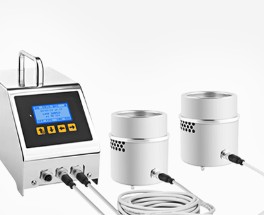
| Characteristic | MULTIFLEX 1 | MULTIFLEX 1+2 | RABS ISOLATOR + 3 satellites |
|---|---|---|---|
| Codes | 483K-486K | 474K-477K | 268K-271K |
| Construction | Stainless steel | Command unit and satellites in stainless steel | Command unit and satellites in stainless steel |
| Aspirating chambers | 1 fixed | 1 fixed + 2 independent | Up to 3 independent |
| Connection | Cables up to 20 m, no stainless steel tubing | ||
| Aspirating heads | Daily Shift Head option: individually packaged sterile heads in technopolymer | ||
| Positions | 1 position, 1 environment | Up to 3 positions or 3 environments | Up to 3 positions or 3 environments |
| VHP disinfection | Suitable | ||
Satellites for different applications
- Stationary satellite with HEPA filter for contact plate: code 262.
- Stainless steel satellite with HEPA filter for Petri plate: code 263.
- Wall cable connection: code 267.
Choosing the sampling points
Representative locations can be chosen with a risk assessment. Each location gets a risk rating (A high, B medium, C low), based on its proximity to the critical area, such as exposed product or vials, and on how easily contamination can transfer towards it. In the example of the release, the active sampler AS02 is inside the unidirectional airflow (rating A) and AS01 is close to it (rating B). The same method is applied to settle plates, contact plates and swabs.
Reference: Cleanrooms and Air Quality – A risk based approach, Dr. Tim Sandle.
The example plan
The press release applies the method to an example cleanroom with 19 control points:
- 2 active samplers: AS02 inside the unidirectional airflow (class A), AS01 close to it (class B).
- 2 settle plates near the exit, one opposite the other (class B).
- 9 contact plates (55 mm): the trolley carrying the sampler and hard-to-clean areas under the unidirectional airflow (class A); floor along the access route, desk, high areas and walls (class B).
- 6 swabs: door handles at the access points, window sills, intercom and other hard-to-clean areas.
The conclusion: TRIO.BAS models let you place the aspirating chambers exactly where the risk is highest, as with AS01 and AS02.
Grade A in 2024
- Gazette, JanActive or settle plates
- Gazette, MarTwo heads
- Release, NovShifts of 3, 6 or 9 hours
- Gazette, Nov2 and 3 heads
- Release, DecFilling lines and isolators
- Release, DecModels for the cleanroom
The Gazette in 2024
- JanActive or settle plates in grade A
- FebWhere to sample in a cleanroom
- MarWhy two heads
- AprAIRBIO ONE RAPID-VIRUS
- MayThe sterile Daily Shift head
- JunThe risk of bioaerosols
- JulA short course in microbiology
- AugCleanroom tips
- SepHow to enter a cleanroom
- OctDetecting viruses fast
- Nov2- and 3-head samplers
- DecActive or passive?
TRIO.BAS in 2024
- JanuaryThe Gazette restarts with grade A
- FebruarySales staff at Villa Cella
- AprilExpoFarma, Mexico
- AprilKorea Lab, South Korea
- MayCleanroom Technology Conference, UK
- JuneAFI Symposium, Rimini
- OctoberRelease: active or passive?
- OctoberIran Pharma, Tehran
- OctoberPharma Microbiology, Sofia
- OctoberWorkshop in Anápolis, Brazil
- NovemberRelease: continuous monitoring in grade A
- DecemberRelease: models for the cleanroom
The year in review is in the June 2025 news.