FAQ
Frequently asked questions on air monitoring
The most requested answers on microbial sampling, particles, ORUM instruments, calibration and service. Technical details for each product are on its own website.
- 67answers
- 10topics
- 3product lines
No answer for this search. Write to us: our technical office will reply. Write to the technical office →
Basics
What is measured, with which media and how often.
What is microbiological air monitoring?
It captures airborne microorganisms on a culture medium. After incubation, two to three days for bacteria and three to six for moulds and yeasts, the colonies are counted as CFU.
Why test the microbial content of air?
Microorganisms travel on particles. They can contaminate a sterile medicine, shorten the life of a food, infect a patient, or damage a sensitive room.
What is the difference between a particle counter and a microbial sampler?
A particle counter measures non-viable particles and does not say whether they carry live microorganisms. A microbial sampler measures viable particles, with the result after incubation. The two instruments are used together.
What is the difference between active and passive sampling?
Active sampling draws a known volume of air onto the plate and gives a result in CFU per cubic metre. Passive sampling leaves a plate open, usually for four hours. It is simpler and less quantitative.
Which culture medium is used?
TSA for total bacterial count. SDA for moulds and yeasts. At least 14-16 ml in a 55 mm contact plate and 24-30 ml in a 90 mm Petri dish.
What are the incubation times and temperatures?
Bacteria: 48-72 hours at 30-37 °C. Moulds and yeasts: 4-6 days at 26-30 °C.
How often should sampling be done?
It depends on the sector. In the highest-risk pharmaceutical areas the references are EU GMP Annex 1 and the manufacturer's Contamination Control Strategy. In food, frequency comes from a site study. In hospital it depends on the ward. Sector notes are on triobas.com.
Why use a 55 mm plate instead of a 90 mm Petri dish?
To keep one plate format and reduce the lots that need a separate validation.
How are surfaces tested?
With 55 mm contact plates pressed onto the surface, using the CPS system. The reference method is ISO 18593.
Choosing the sampler
Flow rate, number of heads, special environments and models.
Why 200 l/min instead of 100 l/min?
For the same volume collected, it halves the operator's time.
Why two or three heads instead of one?
Different media can run together, the same medium can be duplicated, operator time drops, and plates are handled less.
Which sampler is used in an isolator or a RABS?
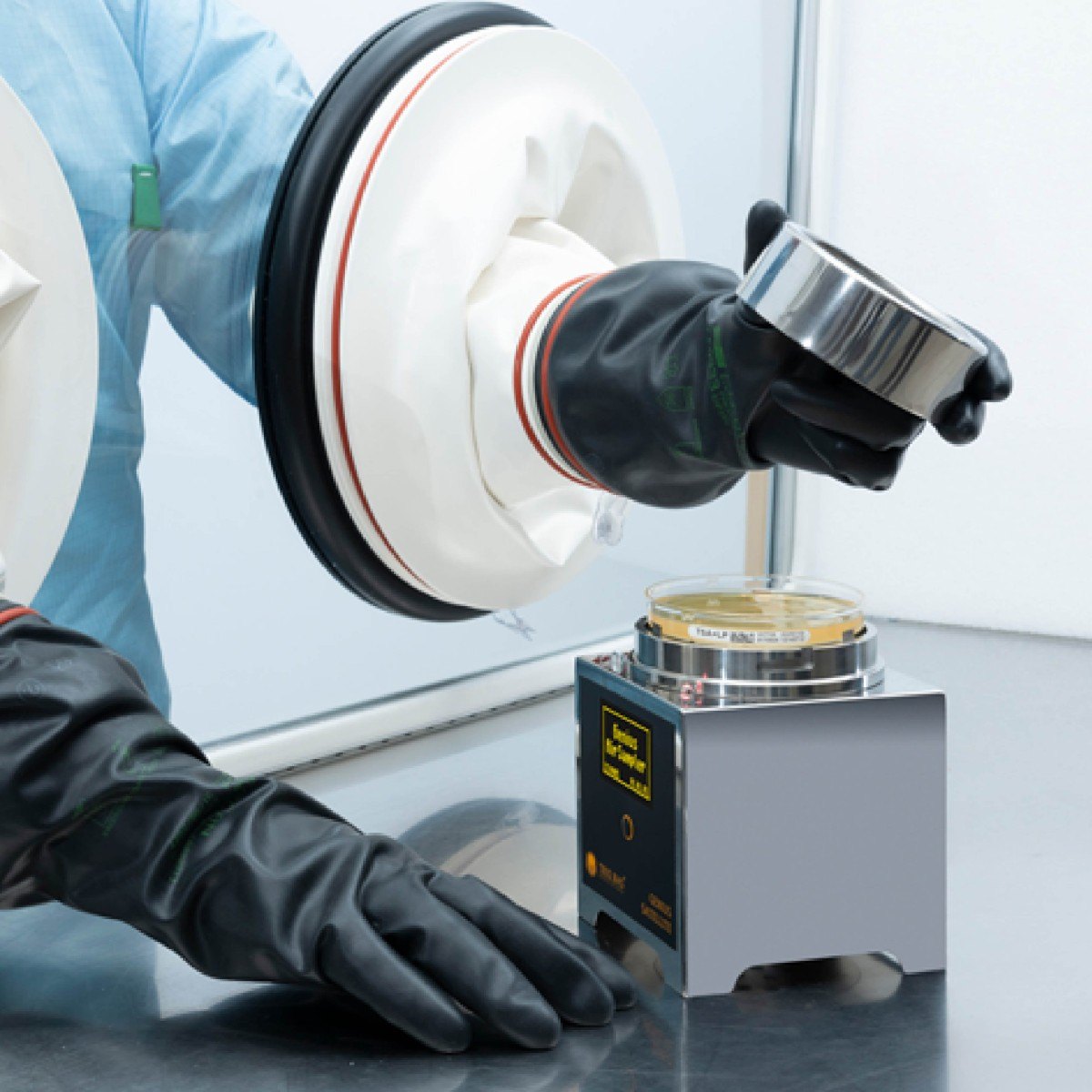
The command unit stays outside. The head, or the funnel model, stays inside.
Can sampling be done in an explosion-risk area?
Yes, if the model has ATEX certification.
How is compressed gas checked in grade A or B?
With an active sampler and the compressed-gas accessory, according to ISO 8573-7. Gases that can be tested: compressed air, nitrogen, carbon dioxide, argon.
How are viruses collected from air?
With Airbio One Rapid-Virus, which collects the aerosol in a liquid for rapid tests (PCR).
What volume of air should be sampled?
It depends on how many microorganisms are expected. The plate should stay easy to count, up to about 150-200 CFU, so the volume is set accordingly (for example 300, 500 or 1,000 litres). The result is then expressed per 1,000 litres, that is per cubic metre.
Which instruments are portable and which are fixed?
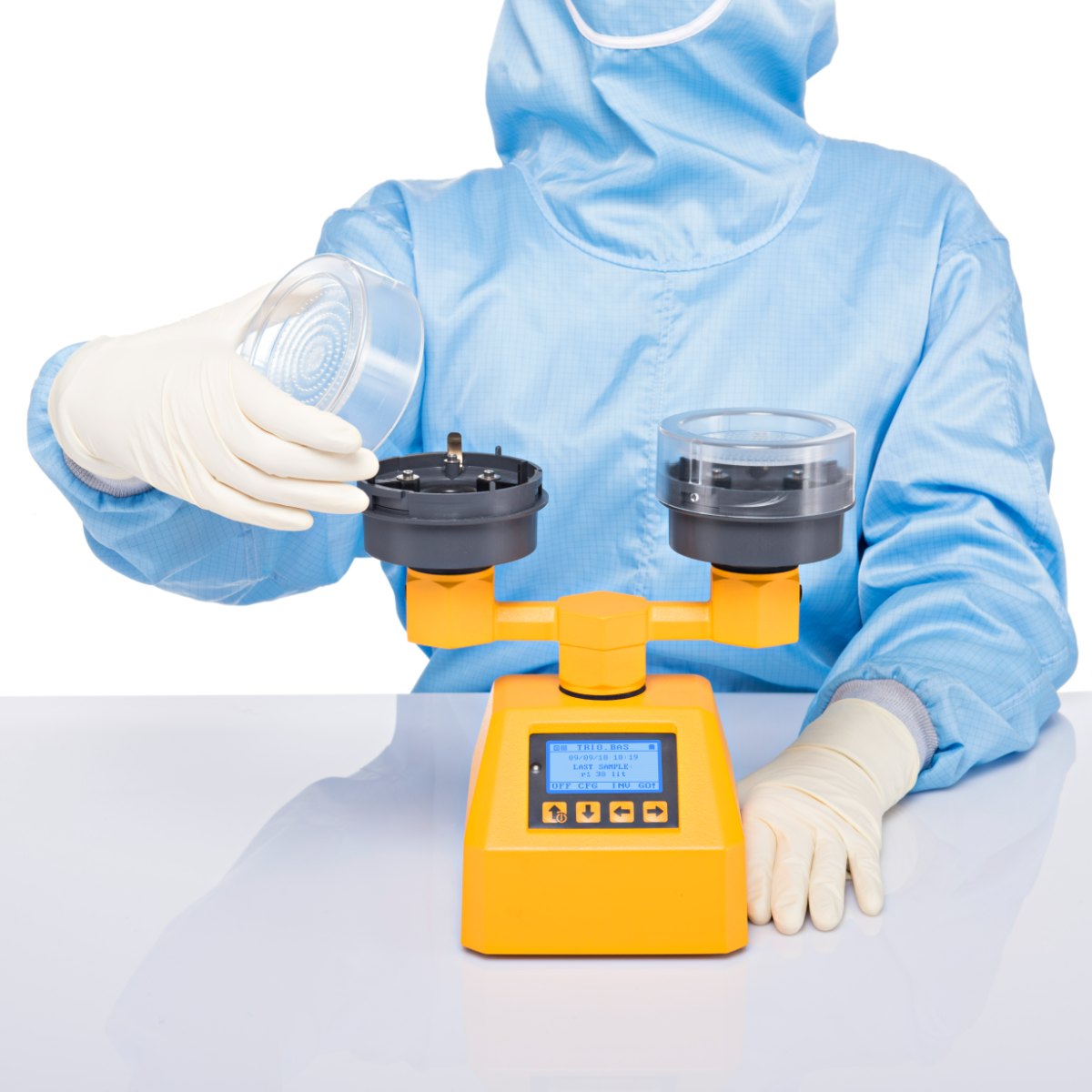
The portable ones are the yellow line: MINI, MONO, DUO, TRIO. The fixed ones are the stainless steel line: ISOLATOR, MULTIFLEX, RABS.
What is the difference between MINI and MONO?
MINI costs less and is meant for agri-food, dairy and beverages, where data integrity is not required for recording results. MONO is for regulated environments.
Heads, plates and functions
The accessories and functions used every day.
Why use sterile heads for daily use?
A stainless steel head has to be autoclaved every day, with its records. A sterile technopolymer head (Daily Shift) lasts a whole working shift, avoids the sterilisation steps and lowers the risk of false results.
Which aspirating heads are used?
Stainless steel head (330-331), technopolymer head (336) and sterile Daily Shift head (340-341).
Are the aspirating heads interchangeable?
Yes, they are made on tightly controlled machines. The operator only needs to check that the holes are clean.
Which plates can be used?
Any 90 mm plastic Petri dish or 55 mm contact plate (RODAC).
Which volumes are preset?
32 volumes, from 30 to 2,000 litres.
Can it be mounted on a tripod?
Yes, every TRIO.BAS model.
How long can the satellite cable be?
The cable between command unit and satellite is 5 m and can be extended up to 20 m.
Does the sampler create turbulence in laminar flow?
Very little: the sampled air exits in the same direction as the flow.
What are interval sampling, remote control and delayed start for?
Interval sampling takes several samples in sequence on the same plate, to get a representative result in operation. Remote control and delayed start let you start the cycle from outside the critical zone, so the operator does not contaminate it.
How is the battery replaced?
Open the bottom of the sampler, disconnect the old battery and connect the new one. Induction charging works by contact, with no connectors or cables.
Use and cleaning
Sterilisation, disinfection and small everyday issues.
How is the stainless steel head sterilised?
In an autoclave for 20 minutes at 121 °C. For disinfection, use 70% sterile isopropyl alcohol.
How is the instrument body disinfected?
In a cleanroom, with a sterile cloth moistened with 70% sterile isopropyl alcohol. In a normal environment, with a clean cloth moistened with 80% alcohol in deionised water.
Can it be sterilised with hydrogen peroxide (VHP)?
Yes, the aspiration chamber can be treated with VHP following the generator maker's instructions. The satellites stay in place during isolator decontamination.
Can the head holes get clogged?
Yes, in very dirty environments. Clean them with compressed air.
After sampling, the hole marks are not visible on the agar. Why?
The medium is probably dehydrated. Check that it is not too old.
Calibration and maintenance
Intervals, certificates and checks between calibrations.
How often is an active sampler calibrated?
Every 12 months, every 6 with heavy use.
What is the difference between calibration and adjustment?
Calibration checks the deviation and produces a calibration certificate. Adjustment brings the instrument back into specification, typically within ±2.5%, and produces an adjustment certificate.
If the display says calibration expired, can sampling continue?
The cycle can start. Results after the expiry may not stand in the official record. Book the calibration before it expires.
Does a new sampler need a new validation?
Yes. A protocol exists for validating the new instrument.
Should the air flow be checked between two calibrations?
Yes. If the flow is out of limits at the next calibration, the results of the whole previous period are not accepted. A check at regular intervals with a suitable instrument avoids this.
What is the difference between in-house checks and official calibration?
An in-house check is done by the company's own staff to confirm the instrument works and is not damaged, for example after a drop or with a worn-out battery. Official calibration is done by a third-party laboratory and produces the document required by authorities such as the FDA.
Where is a TRIO.BAS calibrated?
In the ORUM metrology laboratory in Milan, with a patented high-precision calibration system. If needed, calibration can also be done at your site.
What happens to the instrument in the laboratory?
Every TRIO.BAS goes through nine steps: decontamination, body check, ultrasonic cleaning of the aspirating head, cleaning and check of the aspiration chamber, battery check, flow calibration and adjustment, firmware update, replacement of damaged parts with original spares, and a new calibration certificate.
Results
From the plate count to CFU per cubic metre.
Should the CFU count be corrected with a statistical table?
Yes. Each sampler’s manual includes a statistical table that corrects for more than one microorganism landing under the same hole of the head.
How do you convert CFU per plate to CFU/m³?
Multiply the CFU by 1,000 and divide by the litres sampled. Example: 20 CFU in 200 litres gives 100 CFU/m³. For CFU/ft³, multiply the per-litre value by 28.32.
Two identical samplers give different results. Why?
Microorganisms are not evenly distributed in the air. Check that the samples were taken under the same conditions and at the same point, and that both instruments are decontaminated and calibrated.
Can the colony count be documented?
Yes, with the CFU photo camera (code 337) connected to a PC running BAS Software. The software saves a photo of the plate before and after the manual count, as required by good laboratory practice and 21 CFR Part 11. Each sample can be exported to PDF or printed.
Data and standards
Data integrity, qualification and regulatory references.
What does ALCOA+ mean?
Attributable, legible, contemporaneous, original, accurate, plus complete, consistent, enduring and available. These are the nine requirements of a data record, in the form used by FDA, MHRA, PIC/S and WHO.
What are IQ, OQ and PQ?
IQ checks the installation. OQ checks operation against specification. PQ checks performance in the real process.
What is EN 17141?
The European standard for biocontamination control in cleanrooms. It is used with the Andersen method, ISO 14698-1.
Is the software aligned with 21 CFR Part 11?
It has personal login, role-based functions, an audit trail on every record and an electronic signature. Data are saved in protected files, from which reports are generated.
Where are the environmental monitoring guidelines?
Often cited: USP chapter 1116, WHO guidance on indoor air and on cleanrooms for vaccines, CDC guidance on healthcare infection, and EMA and FDA documents on Data Integrity.
What does a standard operating procedure (SOP) contain?
Identification number, title, purpose, glossary, responsibilities, safety, standards, materials, protocol, non-conformities, references. Examples in the application notes, such as N.14 and N.91.
Continuous monitoring and GENIUS
What EU GMP Annex 1 asks in Grades A and B, and how GENIUS answers.
What does GMP Annex 1 require for viable air monitoring in Grade A?
Paragraph 9.24: continuous viable air monitoring in Grade A for the full duration of critical processing, including aseptic equipment set-up. For Grade B a similar approach should be considered based on risk. Monitoring must capture all interventions, transient events and any system deterioration, without creating risks of its own.
How does GENIUS avoid disturbing the airflow?
Paragraph 9.22 asks to show that sampling does not harm Grade A and B airflow. The exhaust air leaves in the same direction as the airflow, so turbulence is minimal, and each satellite filters it through a HEPA filter.
Why not simply run a conventional sampler for longer?
Under long aspiration the agar dries out and loses its nutrients, so microorganisms grow poorly and counts become unreliable. Annex 1 requires exposure times based on recovery studies that do not allow the medium to dry.
How is dehydration of the medium limited?
With a lower flow rate and more agar: about 25 l/min and Petri dishes with at least 30 ml of medium. GENIUS also offers 15 l/min with a rotating plate that always presents fresh agar.
Does Annex 1 apply outside the European Union?
In most countries, yes. PIC/S adopted an equivalent text, effective from 25 August 2023 and included in the current PIC/S GMP Guide (PE 009-18, in force since 24 September 2026). Sites exporting to the EU must follow EU GMP wherever they manufacture.
Does continuous active sampling replace settle plates?
No, Annex 1 asks for a combination of methods. Active sampling measures contamination in a known air volume; settle plates show what deposits in one position. One GENIUS plate covers up to 4 hours, the same limit Annex 1 sets for settle plates, so both follow the same shift rhythm.
How many sampling points are needed, and where?
They follow from the risk assessment in your contamination control strategy, with points where the product is most at risk. One GENIUS System runs up to 24 satellites, so every point identified can be covered. ORUM designs the layout from your installation drawings.
Particles and CONT.AIR
Particle counting and the ORUM particle counter.
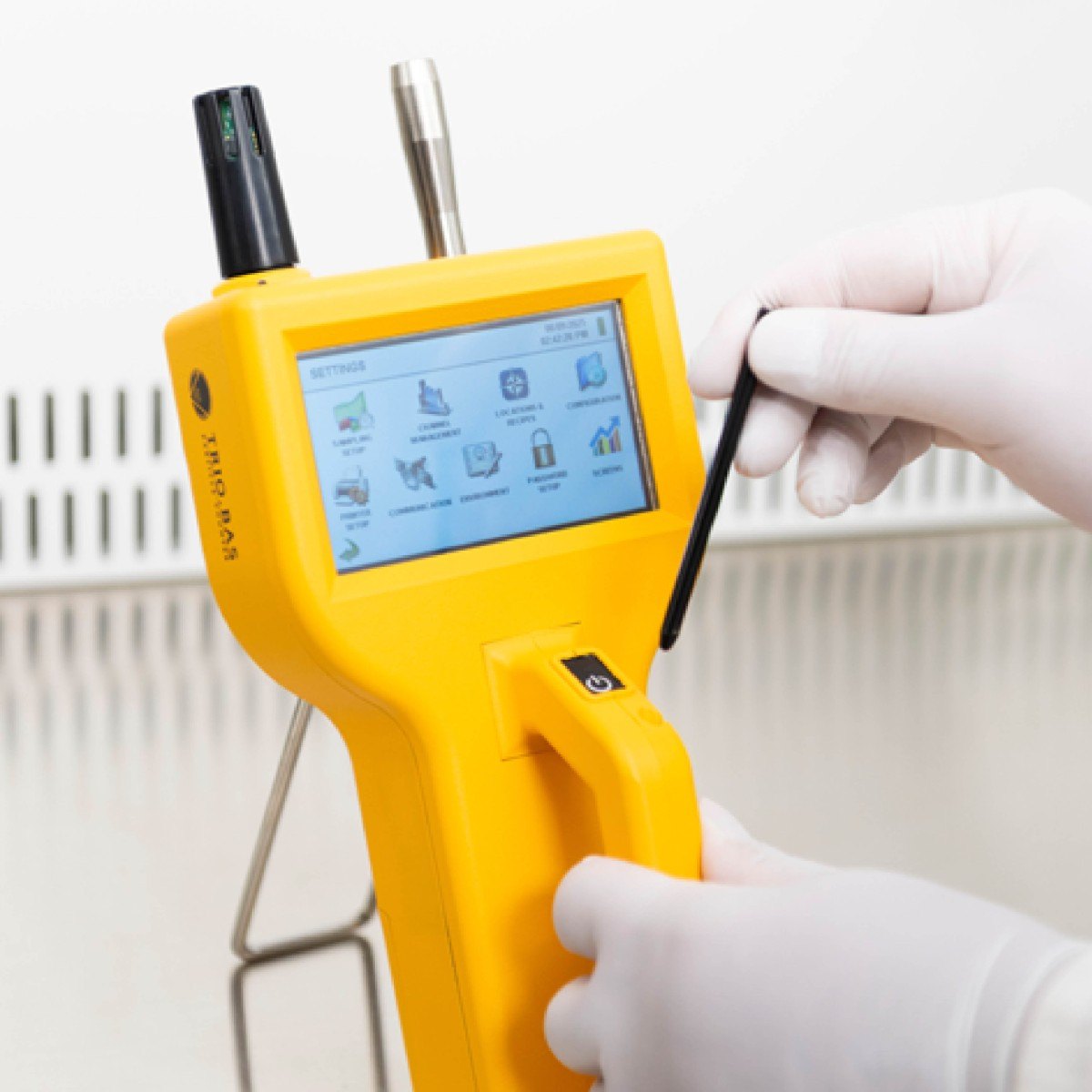
Which particle sizes does CONT.AIR measure?
From 0.3 to 25 µm, on 6 factory-calibrated channels: 0.3, 0.5, 1.0, 2.5, 5.0 and 10.0 µm. The flow rate is 0.1 CFM, that is 2.83 l/min.
Can CONT.AIR be used for indoor air?
Yes. Besides the standard cleanroom formats, it gives data as mass concentration (µg/m³) and has temperature and relative humidity probes. It is used for indoor air quality and HVAC systems.
Which reports does CONT.AIR produce?
Reports to ISO 14644-1, EU GMP Annex 1 and FS 209E. The instrument complies with ISO 21501-4 and JIS B9921.
How long does the battery last?
Over 10 hours of continuous sampling on one charge. The removable Li-ion battery recharges in 4 hours, under 2 with the external charger.
How often should CONT.AIR be calibrated?
At least once a year. Code 917 is supplied with a calibration certificate.
Service and documents
Service requests and technical documents.
How do I request a service visit?
Through the contact form: choose Calibration or Technical assistance and give the instrument type and serial number, the problem and the service you need. We take it from there.
How can I get information about an instrument?
In the contact form, choose Product information and tell us which instrument you are interested in.
Is service available outside Italy?
Yes: fast calibration and repair, in Italy and abroad. ORUM is present in many countries, listed on the TRIO.BAS around the world page.
Where can I find the application notes?
On the Application notes page, with filters by sector. Each note links to its page on triobas.com.
A question that is not here?
Write to our technical office, or compare TRIO.BAS, GENIUS and CONT.AIR to see which instrument you need.