Active or passive air monitoring in cleanrooms?
The number of microorganisms in a cleanroom can be measured with an active or a passive method. The two give very different results.
Active method
- The sampler draws a set air volume
- Air impacts on the agar plate
- Incubation and count
Result: CFU/m³
Passive method
- Open 90 mm Petri dish
- Microorganisms settle by gravity
- Incubation and count
Result: an indication only
In a comparative test the active method is 25 to 45 times more efficient.
The active method
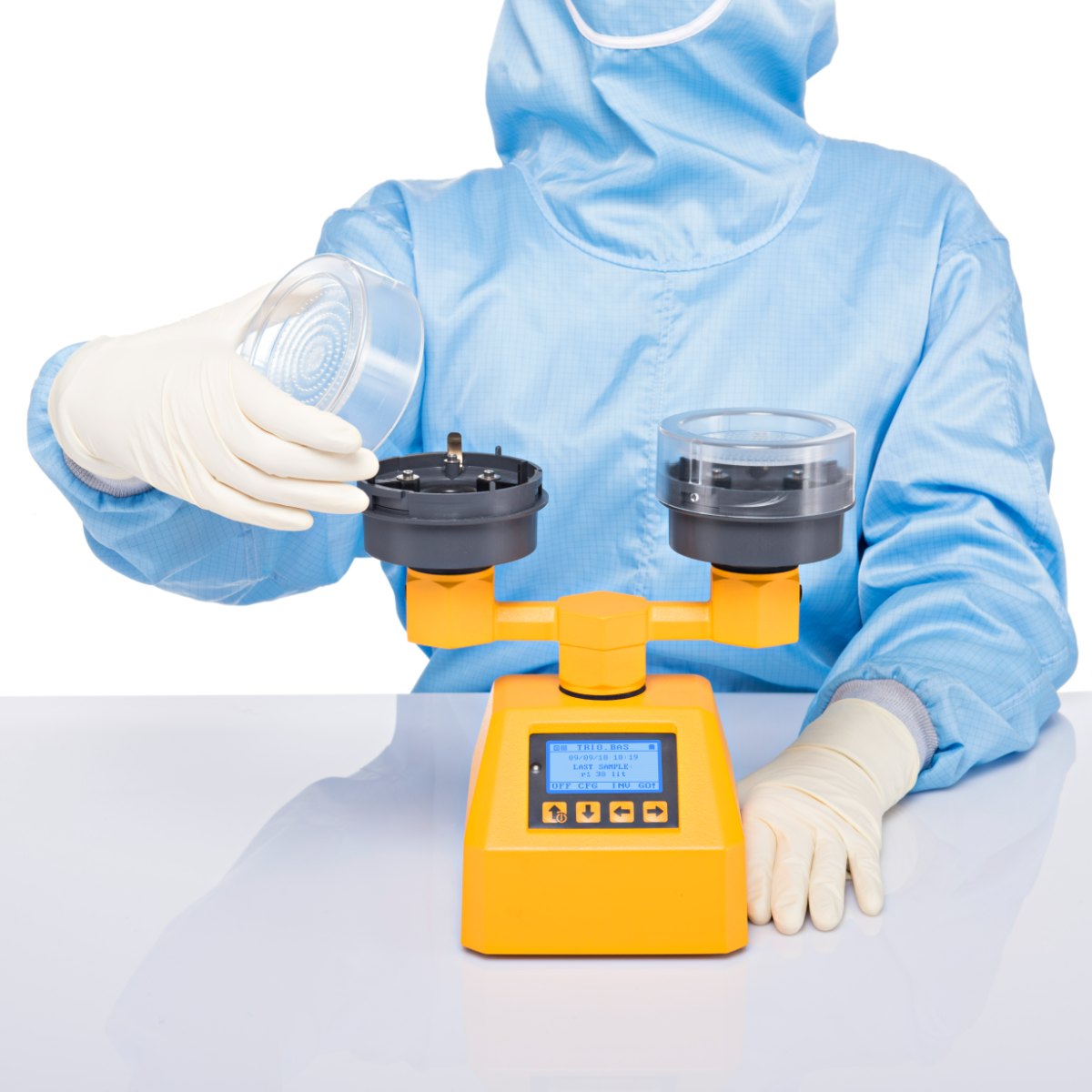
A microbial air sampler draws air into the aspirating chamber, where it impacts on the agar surface of a Petri dish, with programmed time and air volume. After incubation, the colony forming units (cfu) give a cfu per cubic metre value, which is a clear evaluation of air quality in that environment.
The passive method
An open agar plate, usually a 90 mm Petri dish with a medium for total bacterial count or total fungi, is placed on a surface and collects the microorganisms that fall onto it by gravity. After incubation, the cfu give only an indication of air quality. This method is called “settle plates”.
Active versus passive
Any microbiological laboratory can run a comparative test: active monitoring is 25 to 45 times more efficient. The microorganisms collected by sedimentation are only a small part of the microbial population in the room.
Conclusion
The passive method is low cost and simple, and suits environments where quantifiable results are not needed. The active method is an accurate measure of air quality and the preferred option for continuous monitoring in controlled environments such as Grade A cleanrooms.
Active and passive in ORUM news
- May 2023Active and passive for Annex 1
- October 2024The press release
- December 2024The Gazette
- November 2025TRIO.SETTLE for passive sampling
The Gazette in 2024
- JanActive or settle plates in grade A
- FebWhere to sample in a cleanroom
- MarWhy two heads
- AprAIRBIO ONE RAPID-VIRUS
- MayThe sterile Daily Shift head
- JunThe risk of bioaerosols
- JulA short course in microbiology
- AugCleanroom tips
- SepHow to enter a cleanroom
- OctDetecting viruses fast
- Nov2- and 3-head samplers
- DecActive or passive?
TRIO.BAS in 2024
- JanuaryThe Gazette restarts with grade A
- FebruarySales staff at Villa Cella
- AprilExpoFarma, Mexico
- AprilKorea Lab, South Korea
- MayCleanroom Technology Conference, UK
- JuneAFI Symposium, Rimini
- OctoberRelease: active or passive?
- OctoberIran Pharma, Tehran
- OctoberPharma Microbiology, Sofia
- OctoberWorkshop in Anápolis, Brazil
- NovemberRelease: continuous monitoring in grade A
- DecemberRelease: models for the cleanroom
The year in review is in the June 2025 news.