Continuous microbial air monitoring in the cleanroom
Microbial monitoring of the cleanroom matters in the production of sterile medicines. The most critical point is the aseptic filling line, where the product is not terminally sterilised.
Guidelines and authorities ask for less than 1 CFU per 1,000 litres (1 m³) of air. A shift lasts several hours, so a continuous monitoring protocol must cover the whole process.
Continuous monitoring uses multi-head samplers: with TRIO.BAS DUO or TRIO.BAS TRIO the shift can be monitored for 1 to 8 hours.
Using several heads at once, instead of one head for several cycles, also reduces operator interventions. Preparing all the heads together lowers the risk of secondary contamination.
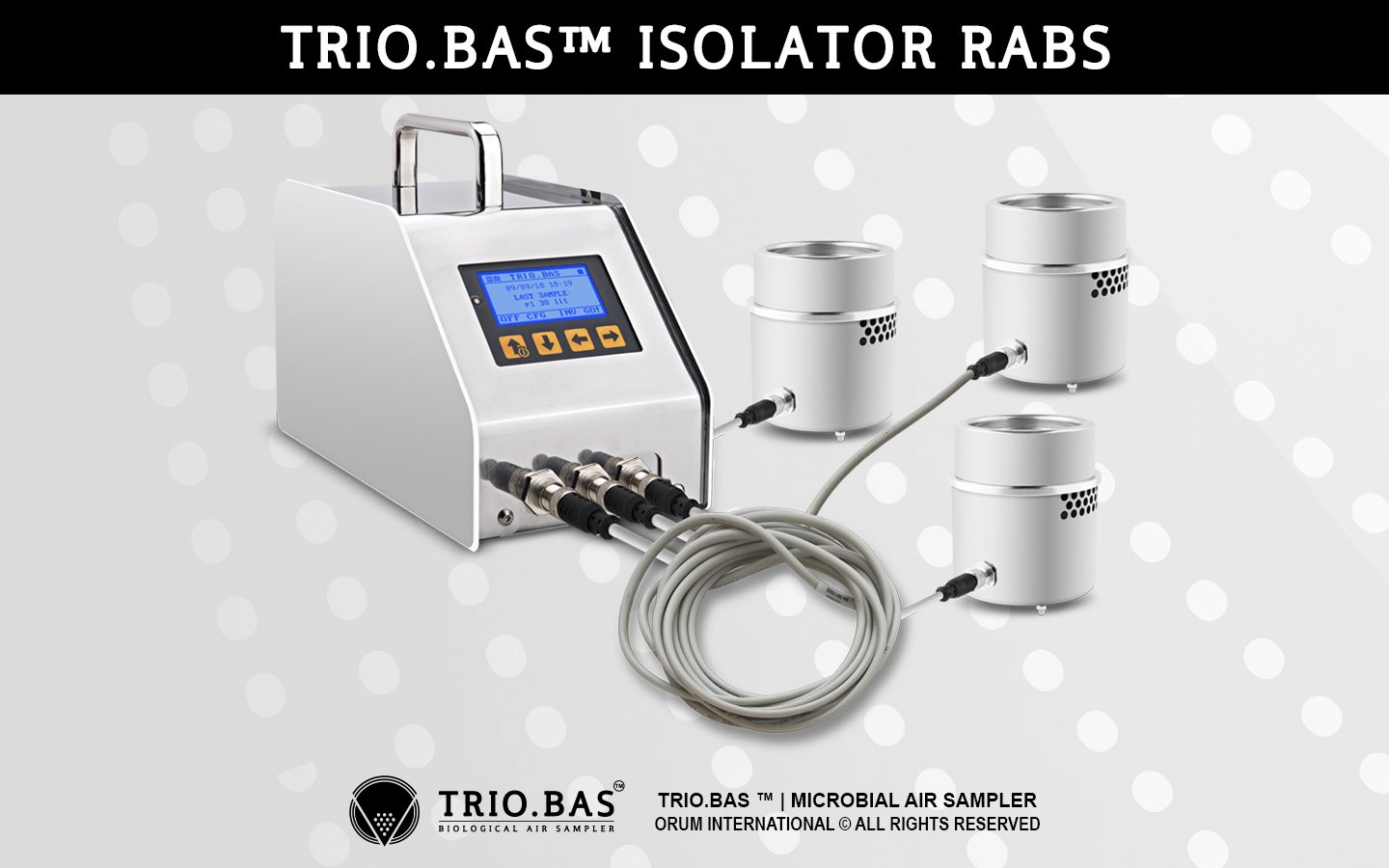
Product page: TRIO.BAS ISOLATOR RABS on triobas.com.
The Annex 1 limits
The 2008 EU GMP Annex 1 sets recommended limits for air samples, as average values in CFU per cubic metre. Grade A, where aseptic filling takes place, has the lowest limit.
From sampling plans to continuous monitoring
- July 2019ASCCA News: plans under USP
- October 2019PDA poster: one head or three
- December 2019BJSTR mini review
- April 2020Continuous monitoring
TRIO.BAS in 2020
- FebruaryMini review on sampling plans
- FebruarySeminars in Indonesia
- FebruaryLIAS 2020 in Kyiv, with HLR
- MarchLockdown: ORUM keeps working
- AprilASCCA News no. 1/2020
- AprilAIRBIO DUO in Rapid Microbiology
- AprilContinuous cleanroom monitoring
- JuneLab+Life Scientist, Australia
- JuneWebinars on the 2020 products
- SeptemberASCCA webinar on air conditioning systems
- NovemberThe yellow family video
- NovemberThe stainless steel line video
Sources: Commissione europea, EU GMP Annex 1 (2008); GMP Insiders.