ASCCA News: air sampling in the pharma and food industries
Issue 1/2021 of ASCCA News runs a two-page article in its “Back to Basics” section on microbial air sampling in the pharmaceutical and food industries.
- Intake1,000 litres, one cubic metre
- Impacton a 90 mm Petri dish or a 55 mm contact plate
- Incubation24-48 hours or more; TSA for bacteria, SDA for moulds and yeasts
- Countcolonies per volume of air: CFU/m³
Why the air is tested
In critical production, microbial contamination comes through four routes: room air, compressed air or gases, contact surfaces and liquids. The article focuses on room air, which is tested to validate the HVAC system and disinfection procedures, to check critical points and to make sure compressed air is not contaminated.
The active method
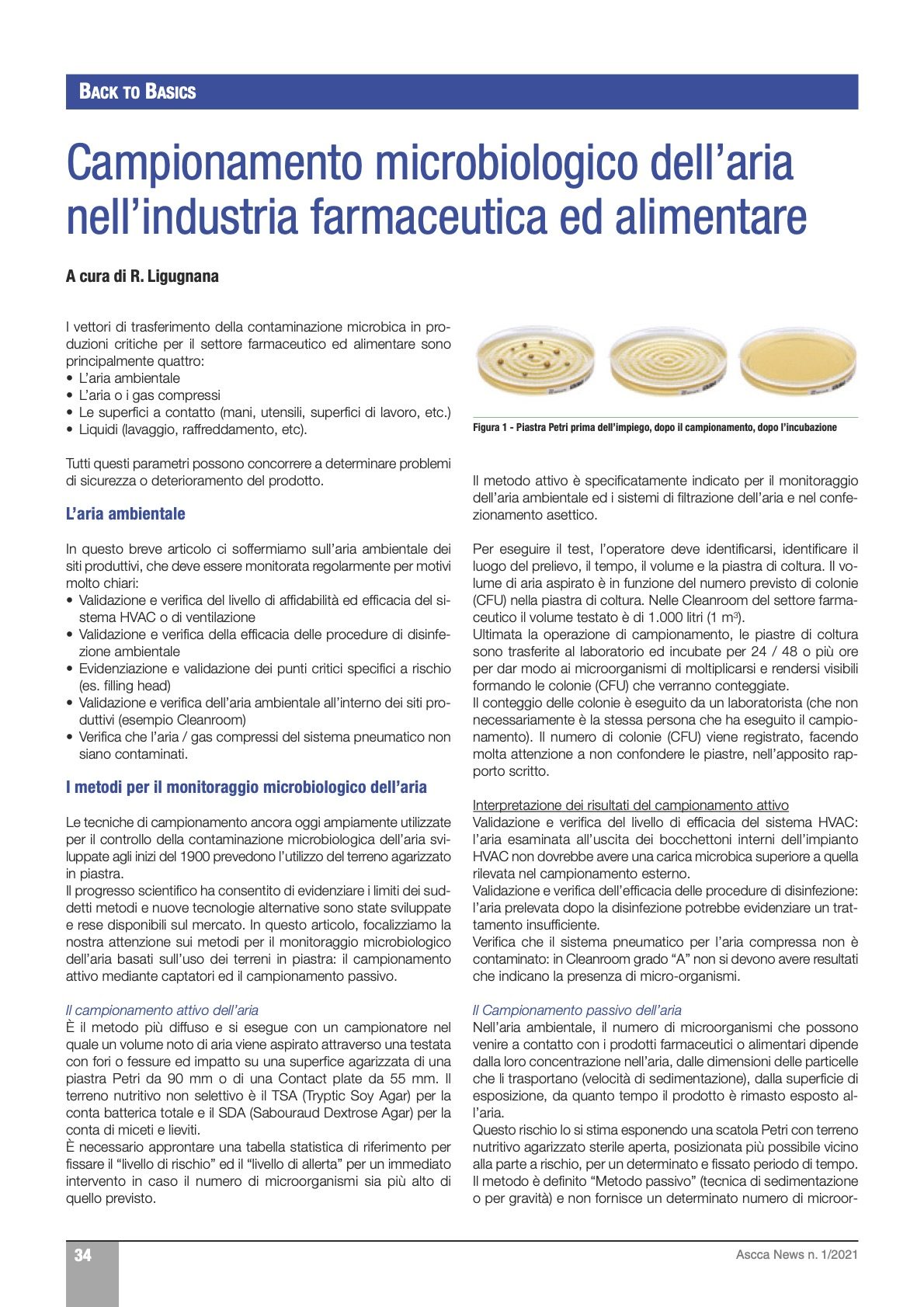
A sampler draws a known volume of air through a perforated head, which makes it impact on a 90 mm Petri dish or a 55 mm contact plate. TSA is used for the total bacterial count, SDA for moulds and yeasts. In pharmaceutical cleanrooms the volume is 1,000 litres, one cubic metre. Plates are incubated for 24-48 hours or more, then the colonies are counted.
The passive method
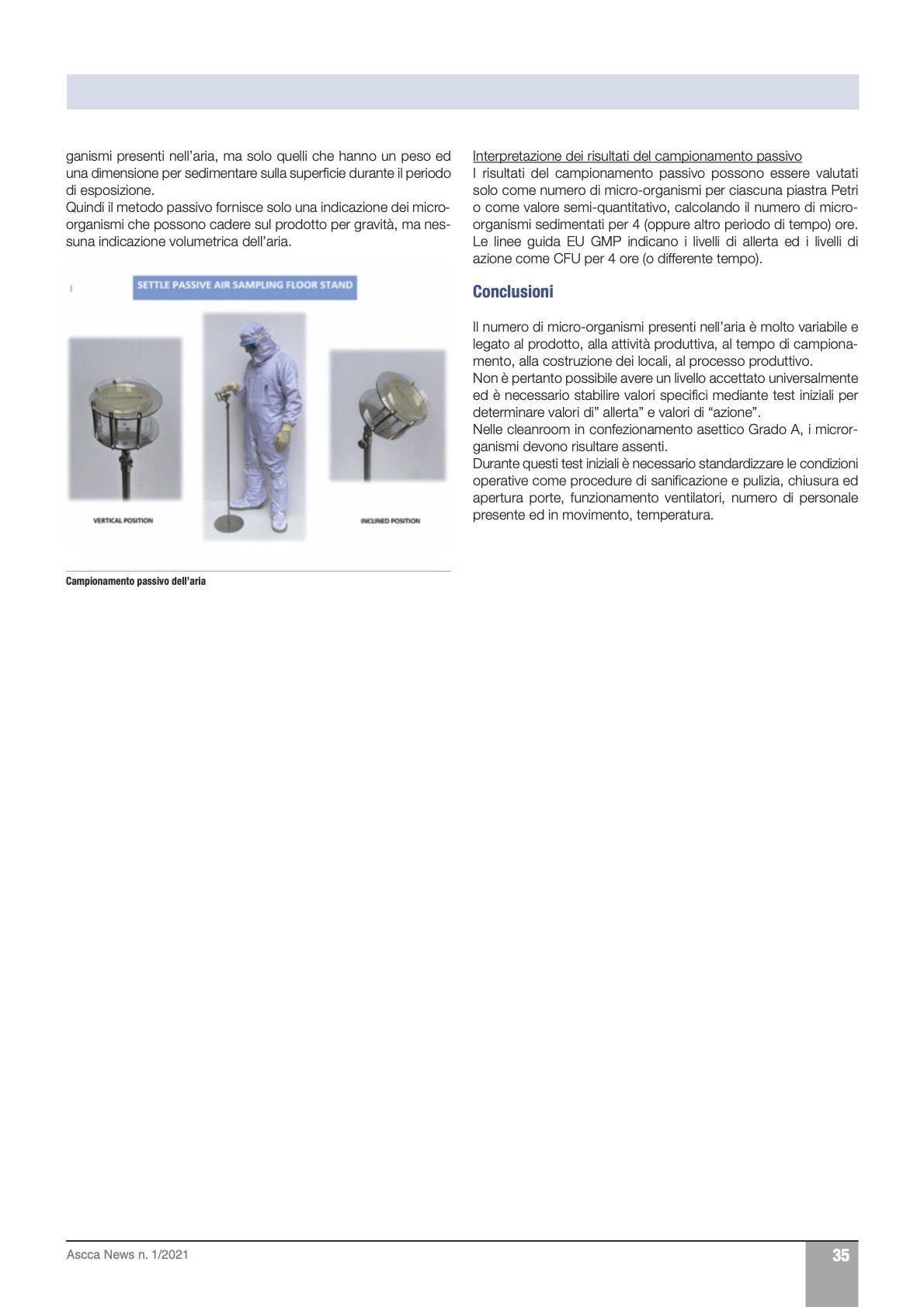
A plate with sterile medium stays open near the point at risk for a set time. It counts the microorganisms that settle by gravity, but gives no figure per volume of air. EU GMP guidelines set alert and action levels as CFU per 4 hours.
Conclusions
The number of airborne microorganisms varies widely with the product, activities, premises and process. No limit fits everyone: alert and action levels come from initial tests under standardised operating conditions. In grade A aseptic filling, microorganisms must be absent.
The same issue also carried the TRIO.BAS yellow family page.
TRIO.BAS with ASCCA
- 3/2019the TRIO page
- 1/2020the TRIO page
- September 2020the on-air webinar
- 1/2021the yellow family
- 1/2021Back to Basics
TRIO.BAS in 2021
- JanuaryThe first Gazette issue
- FebruaryGazette: contamination and HVAC outlets
- FebruaryWebinar on the 2021 products
- MarchWebinar on BAS software and P.A.C.A.S.
- MarchGazette: continuous monitoring
- MarchASCCA News: the yellow family
- MarchASCCA News: Back to Basics
- MayGazette: the Daily Shift head SOP
- SeptemberRABS and isolators for grade A
- OctoberCleanroom Technology covers the news
- OctoberRapid Microbiology covers the news
- OctoberForum Labo Paris, with Alliance Bio Expertise